
Did an Unexpected Brand Just Launch the Year’s Most Interesting Dive Watch?

This ain’t your dad’s diver.

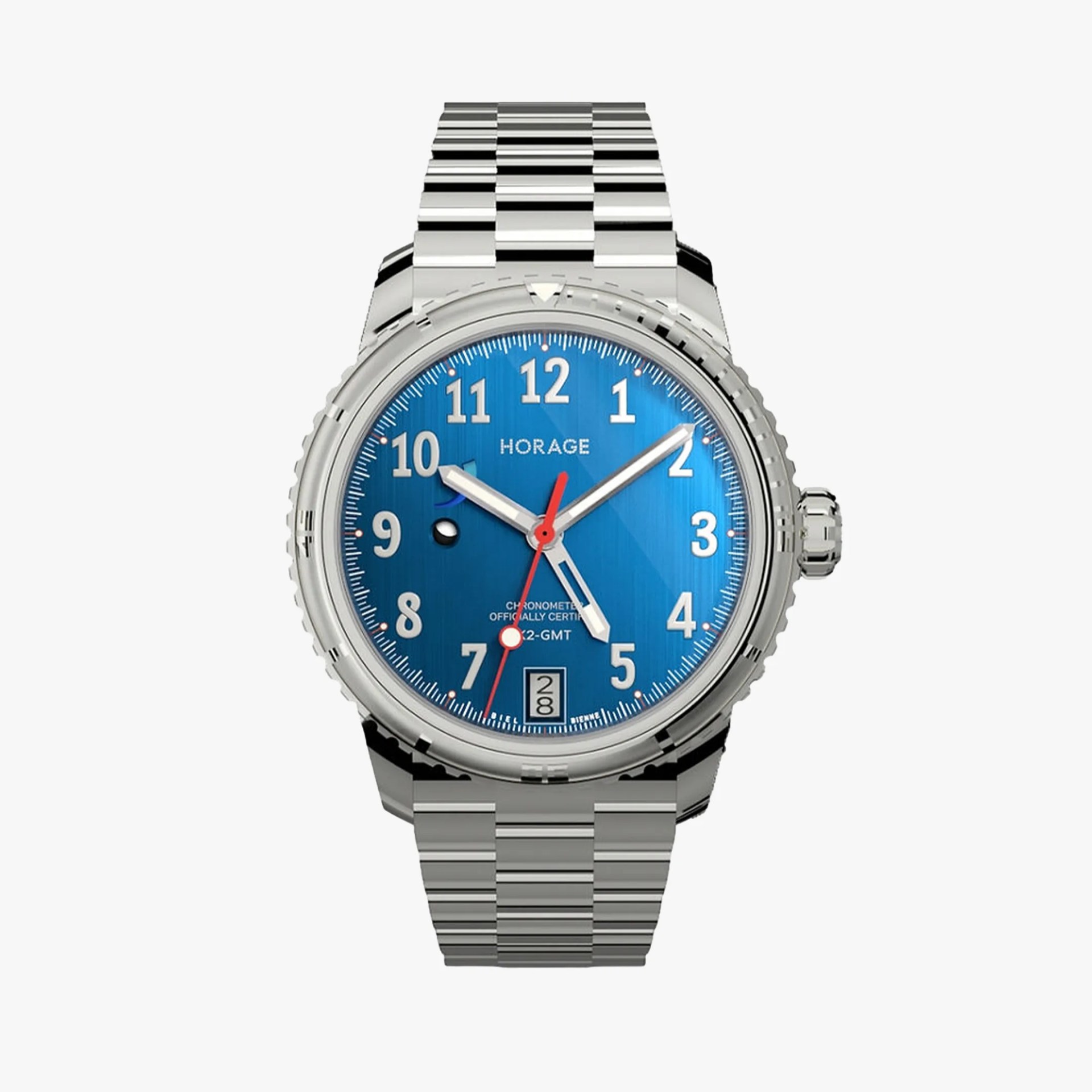
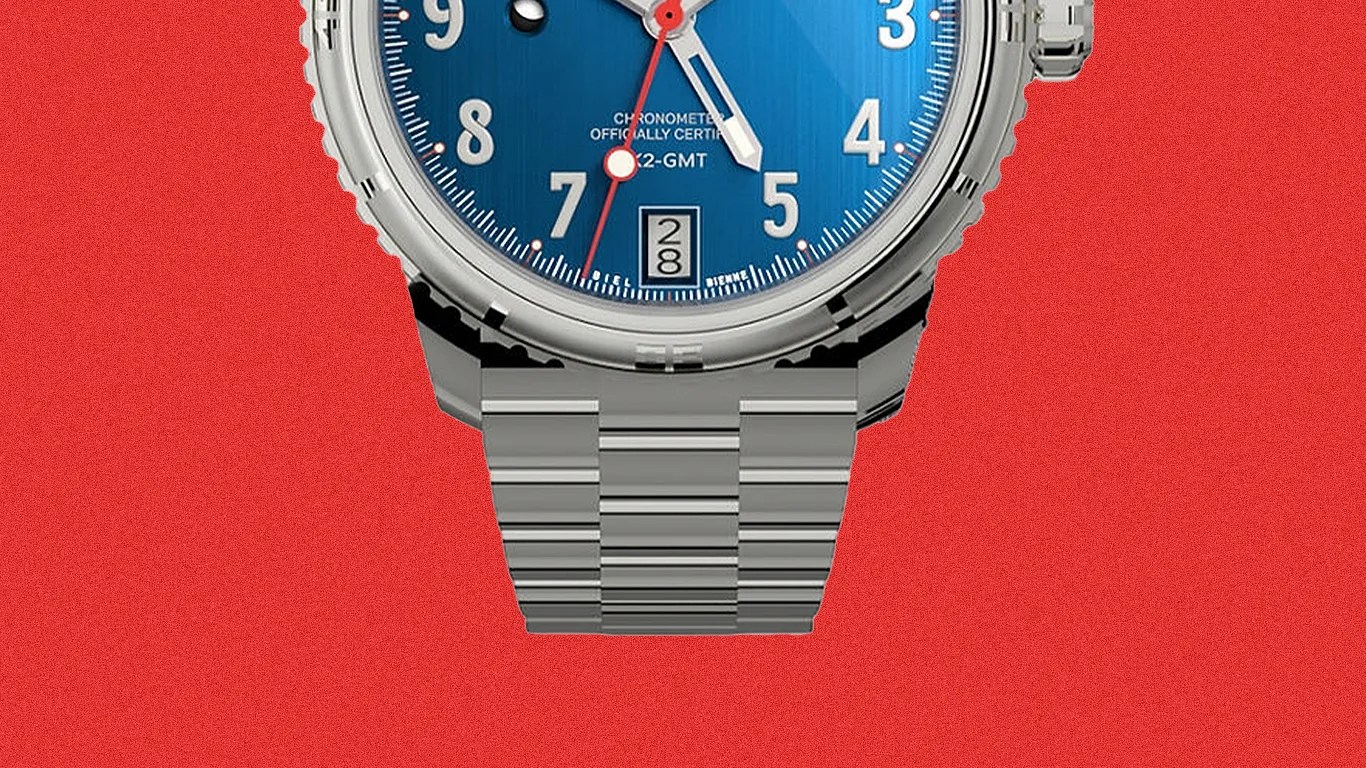
Silver metal watch with a blue dial, white numerals, red second hand, and date display on a red background.Horage

If you buy from a link, we may earn a commission. Learn more

Swiss independent watch brand Horage hasn’t been around that long compared to its centuries-old competition — the brand launched just 17 years ago — but it’s already carved out a nice little niche for itself within the industry by offering impressive in-house movements and complications at unheard-of prices.

Horage makes its own tourbillons and micro-rotor movements, both ranking as the most affordable Swiss-made options. The brand never stops innovating, and has even come up with a novel way of allowing owners to regulate their mechanical watches themselves without even opening up the caseback.

Horage’s latest watch brings the brand back to the dive watch space, but this is far from your average diver. It combines an in-house micro-rotor movement, high-end complication and one-of-a-kind styling to create what has to be the most interesting dive watch of this young year.
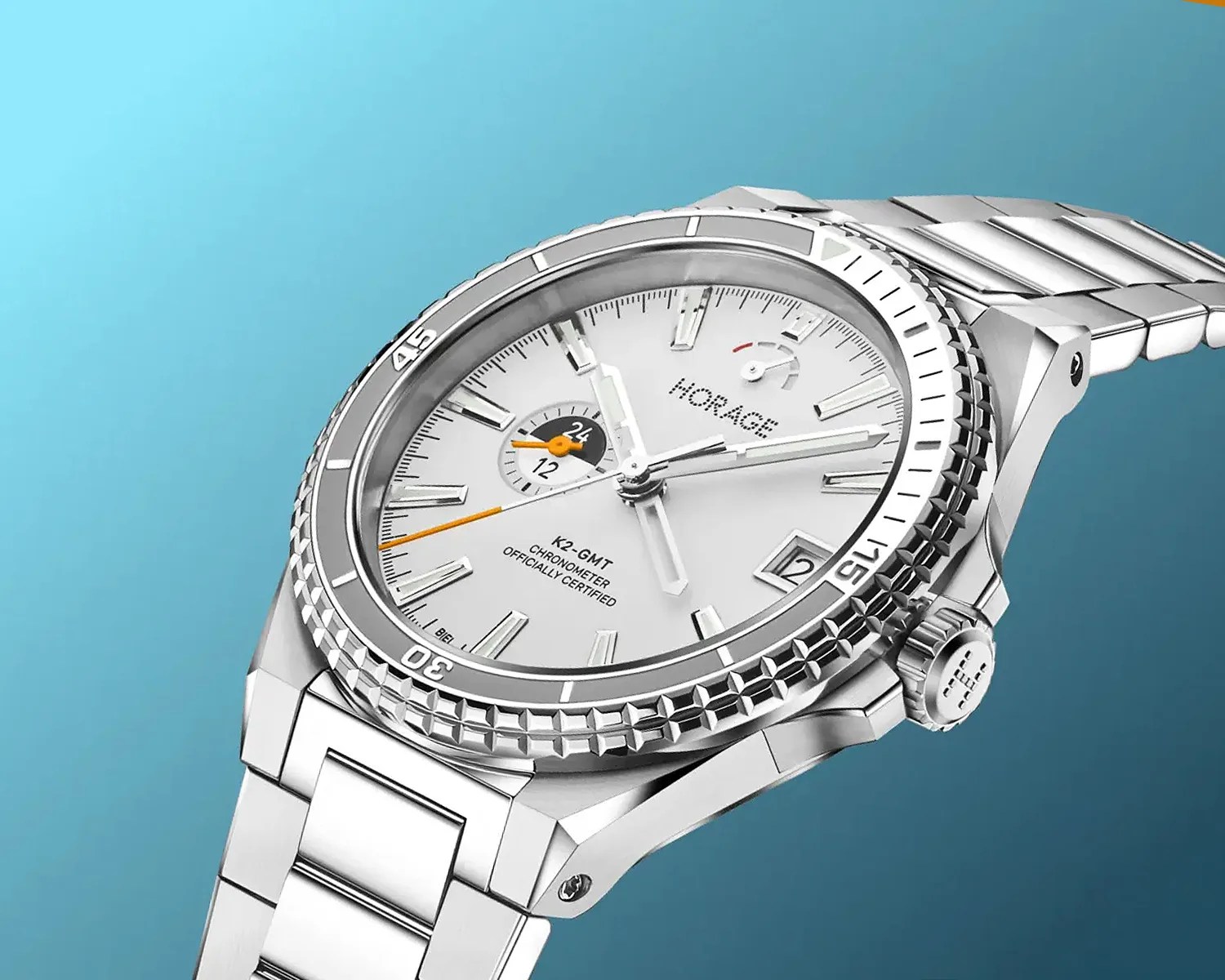
Silver stainless steel Horage K2-GMT chronometer watch with white dial and orange second hand on a blue background.
The Horage Supersede is getting some company in the dive watch category.
Horage

One weird dive watch

Horage has made dive watches before with its Supersede series, and it’s new diver — the Molokini — shares a lot in common with the Supersede GMT that launched in 2022. Namely, both watches are powered by the same in-house movement: the 3.6mm-thick variant of Horage’s Calibre K2 Micro-Rotor movement.

The movement is the most technically impressive aspect of the watch, and it has a ton going for it. Obviously, the winding mass is a micro-rotor, which is made of gold-plated tungsten. There is also a quartet of handy complications: a date, power reserve display, “true” GMT function and a day/night indicator.
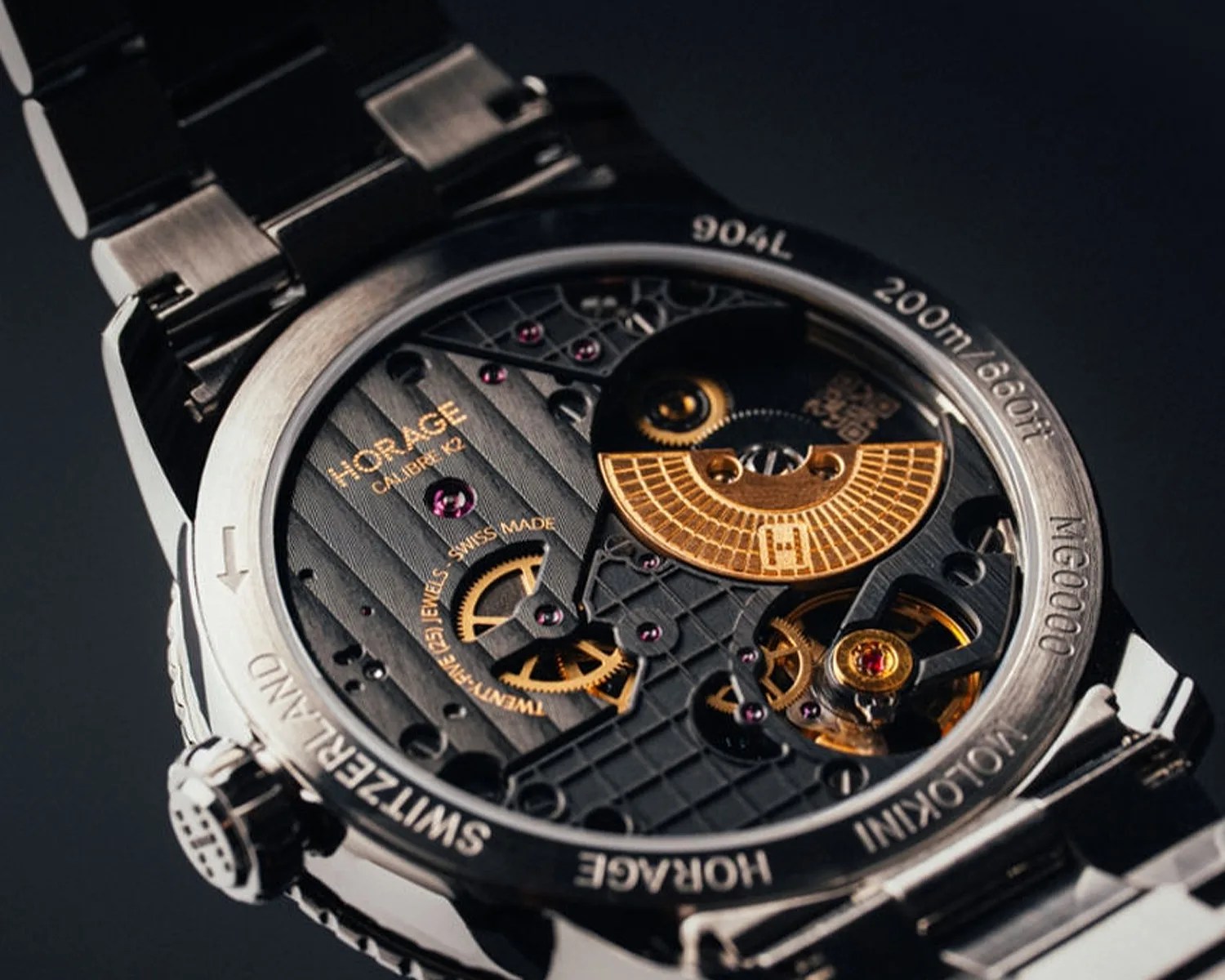
The movement is COSC-certified as a chronometer, boasts a 72-hour power reserve, has an amagnetic silicon balance spring and escapement, and is hand-finished with a mix of classic and contemporary techniques.

Close-up of the back of a Horage wristwatch showing the intricate mechanical movement with gold and purple details.
I gotta say, Horage makes some seriously cool-looking movements.
Horage

The case and bracelet of the Molokini also share a lot in common with the Supersede, as both utilize 904L stainless steel for its improved luster and corrosion-resistance, both feature domed sapphire crystals with several layers of anti-reflective coating, both boast Horage’s proprietary HMAC microadjustable clasp offering a crazy 10mm of travel, and both are water-resistant to 200m.

However, the Molokini clocks in with more compact dimensions than the Supersede at 38mm across, 9.65mm thick and just 44.6mm from lug to lug. That’s compared to 39.5, 9.85mm and 46.29 lug-to-lug. The case and bracelet are also in a more traditional diver style, ditching the Supersede’s integrated design for classic lugs and an Oyster-esque bracelet.

But the biggest differentiator between the Molokini and the Supersede comes down to their styling.

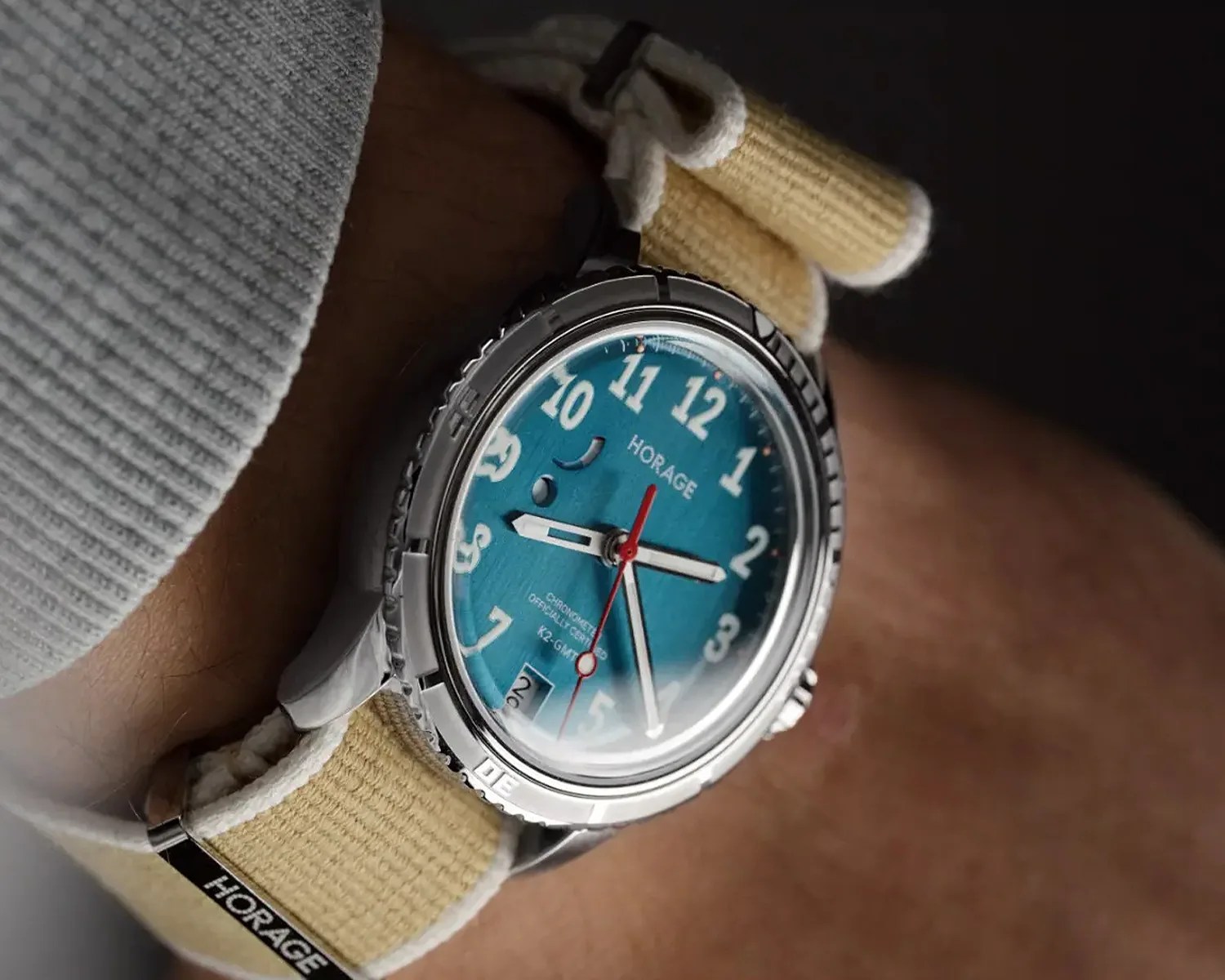
Silver wristwatch with a blue dial, white numerals, red second hand, and beige fabric strap worn on a wrist.
I’ve never seen a diver quite like this before.
Horage

While the Supersede is an undeniably impressive dive watch, I could never get behind its styling. It just looked like a very basic, cookie-cutter diver with a date window at three, and then an extra hand, a power reserve indicator and day/night indicator haphazardly slapped on the dial. It just looked kinda cheap, especially considering what it was packing under the hood.

The Molokini fixes this problem by establishing a visual identity that looks unlike any other diver on the market. First, it moved the date from 3:00 to 6:00 for greater symmetry. Uniquely, it also features a vertical date display, so on days when the date is two digits, they’re displayed on top of the other. I’m not sure I’ve seen that before.

The power reserve and day/night indicators are still there, but they’re taking up far less real estate. The 24-hour subdial is gone, replaced by a small, simple disc that changes from dark to light, while the power reserve meter also ditches its hand and traditional display for a compact arched cutout that turns blue when the watch is powered up.

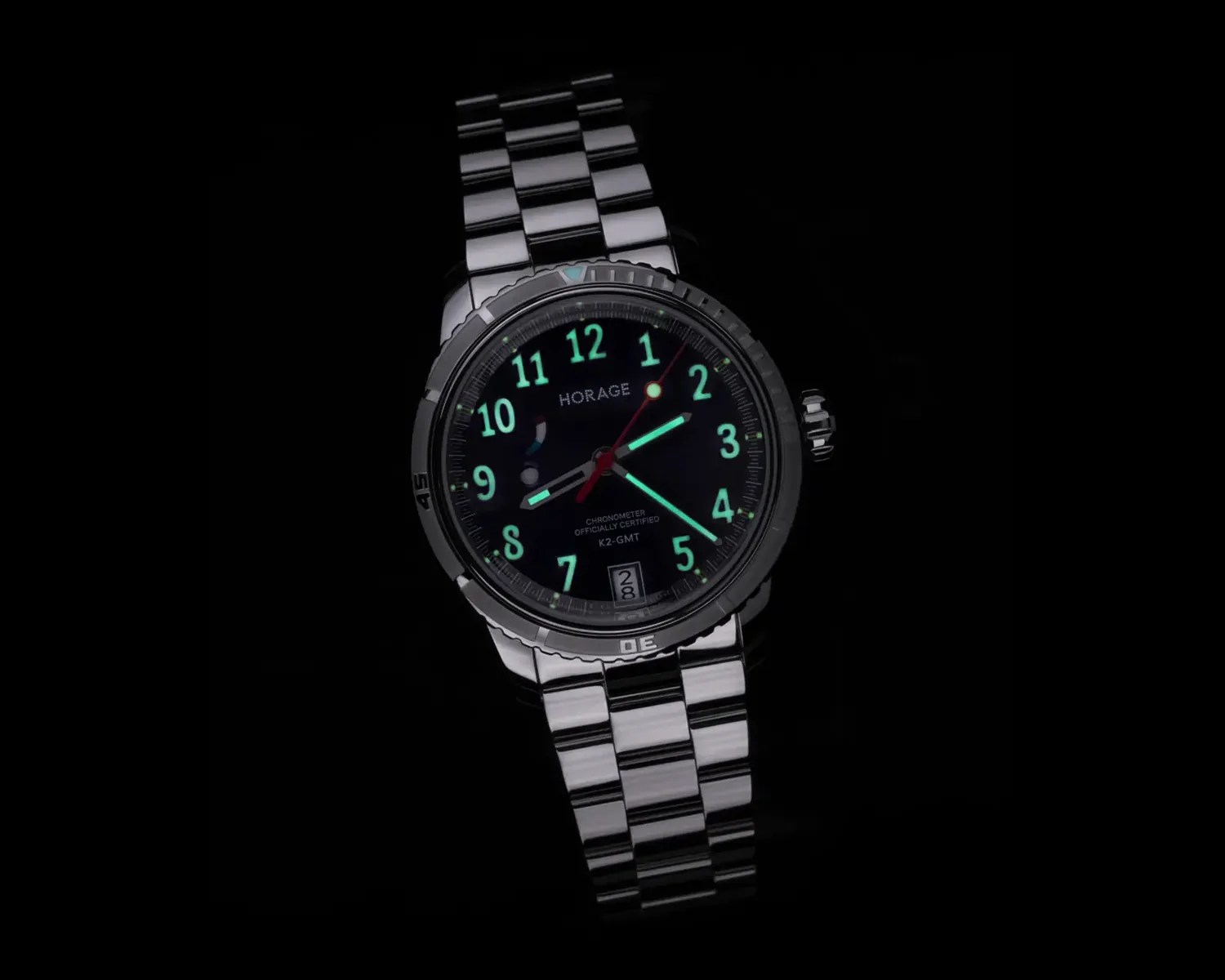
Stainless steel Horage watch with luminous green numerals and hands on a black dial.
It’s a diver, of course there’s lume.
Horage

The two displays are located at 9 and 10 and blend in well, reminding me a bit of the minimalism that Moser routinely uses to display complex complications in as little space as possible.

The handset has also been made slightly less confusing. The hour and minute hands are no longer semi-skeletonized but completely solid fencepost hands, which makes them more distinguishable from the skeletonized GMT hand. The seconds hand is a lot bolder now, too, as it’s entirely red with a lumed lollipop tip.

This is a 12-hour GMT movement, my preferred travel watch setup, with the fourth hand tied to the 24-hour indicator. Since it’s a “true” GMT, The local hour hand can be “jumped” independently without stopping the movement.

The dial has done away with the generic applied indices of the Supersede and replaced them with Arabic numerals printed in Super-LumiNova. It gives the watch a bit of a field watch vibe and looks decidedly unlike any other diver dial, especially given their old-timey font. The bezel remains in steel with polished relief markings, but it’s more rounded than before and has just one row of knurling on the edge rather than two.

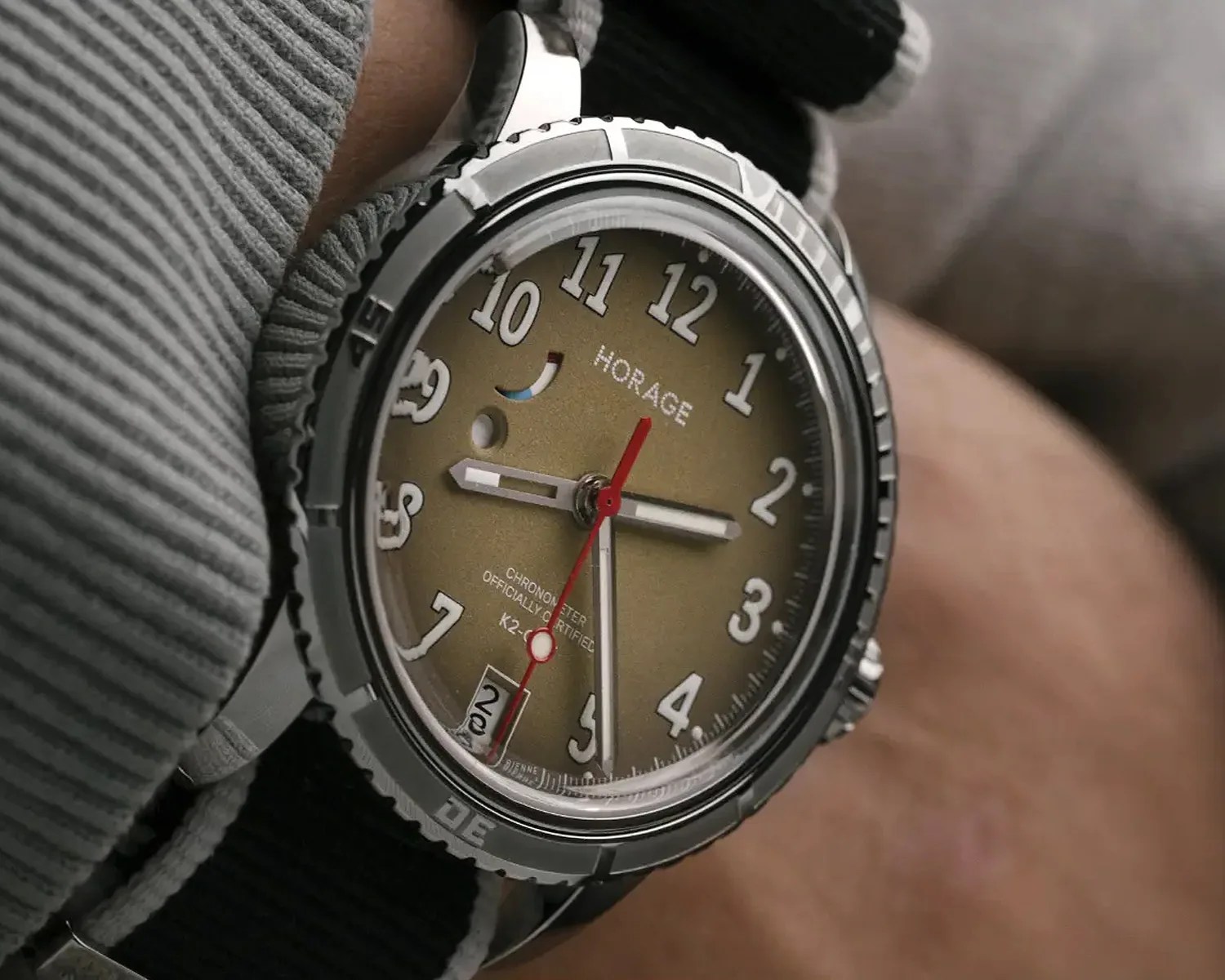
Then we have the colors. There are three options for the Molokini’s dial, each with a different finish. There’s a sunburst Coral Purple, a vertically brushed Ocean Blue, and a sand-textured, uh, Sand. All three were inspired by the beaches of Hawaii, as Horage set out to prove that horology can still be fun and playful with the Molokini.

Close-up of a wristwatch with a metallic bezel, olive-green dial, white numerals, red second hand, and black fabric strap.
The Sand-colored dial also features a grained texture.
Horage

Availability and Pricing

In addition to the bracelet, the Molokini includes an extra fabric strap in the color of your choice: Red/Orange with White edging, Black with White edging or Sand with White edging.

Regardless of what color you choose, the price remains the same. Currently, the Molokini is available to preorder on Horage’s website for CHF 5,990 (~$7,803) until the end of February, after which the price rises to CHF 6,490 (~$8,455).

$8,500 is still technically a good deal for these kinds of specs. You won’t find a Swiss-made micro-rotor-powered diver with an in-house true GMT movement for less — partly because no other such watch exists outside of Horage, to my knowledge. But that’s still a big chunk of change for a Swiss dive watch when you’ve got established luxury brands like Omega and Breitling pumping them out for less.

Silver metal wristwatch with a blue dial, white numerals, red second hand, and date display at 6 o'clock.Horage

Horage Molokini

Specs

Case Size 38mm
Movement Horage Cal. K2 Micro-Rotor automatic GMT
Water Resistance 200m

Want to stay up to date on the latest product news and releases? Add Gear Patrol as a preferred source to ensure our independent journalism makes it to the top of your Google search results.

add as a preferred source on google
, , ,