An Unexpected Brand May Have Just Revolutionized a Basic Car Feature

Even luxury automakers are looking for solutions to everyday problems.

Center console of a luxury car featuring a chrome gear shifter with the Bentley logo, surrounded by carbon fiber trim. The console includes cup holders, various control buttons, and a rotary dial for engine start/stop. The interior is upholstered in dark green leather with orange accents and detailed stitching. The dashboard above shows climate control and media buttons.Bentley

Despite the many conveniences that modern luxury cars afford, it appears that even the upper crust of the automotive world still hasn’t perfected one of the industry’s basic features: cupholders.

That’s because, of all brands, Bentley just patented a design that intends to remedy some longstanding issues in vehicular beverage accommodation.
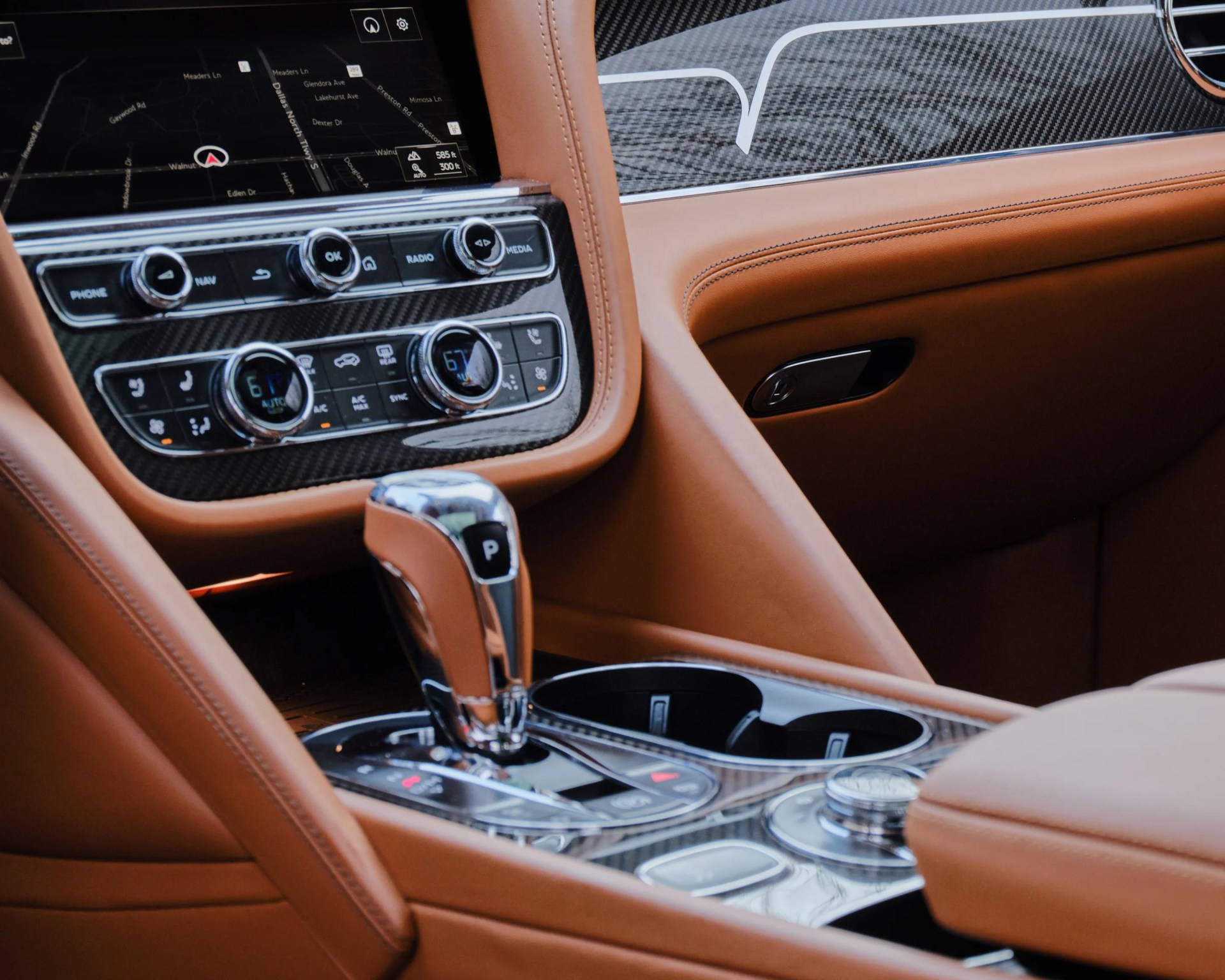
Car interior center console featuring a gear shift lever with a "P" button, dual cup holders, climate control knobs, media and navigation buttons, and a touchscreen displaying a navigation map. The interior is upholstered in brown leather with carbon fiber trim accents.
Bentley’s interiors are undeniably lavish, so it’s no surprise that the automaker would want to protect its furnishings from spillage.
Bentley

Sure, it’s something of a first-world solution to a first-world problem, but it’s one that most drivers can relate to all the same.
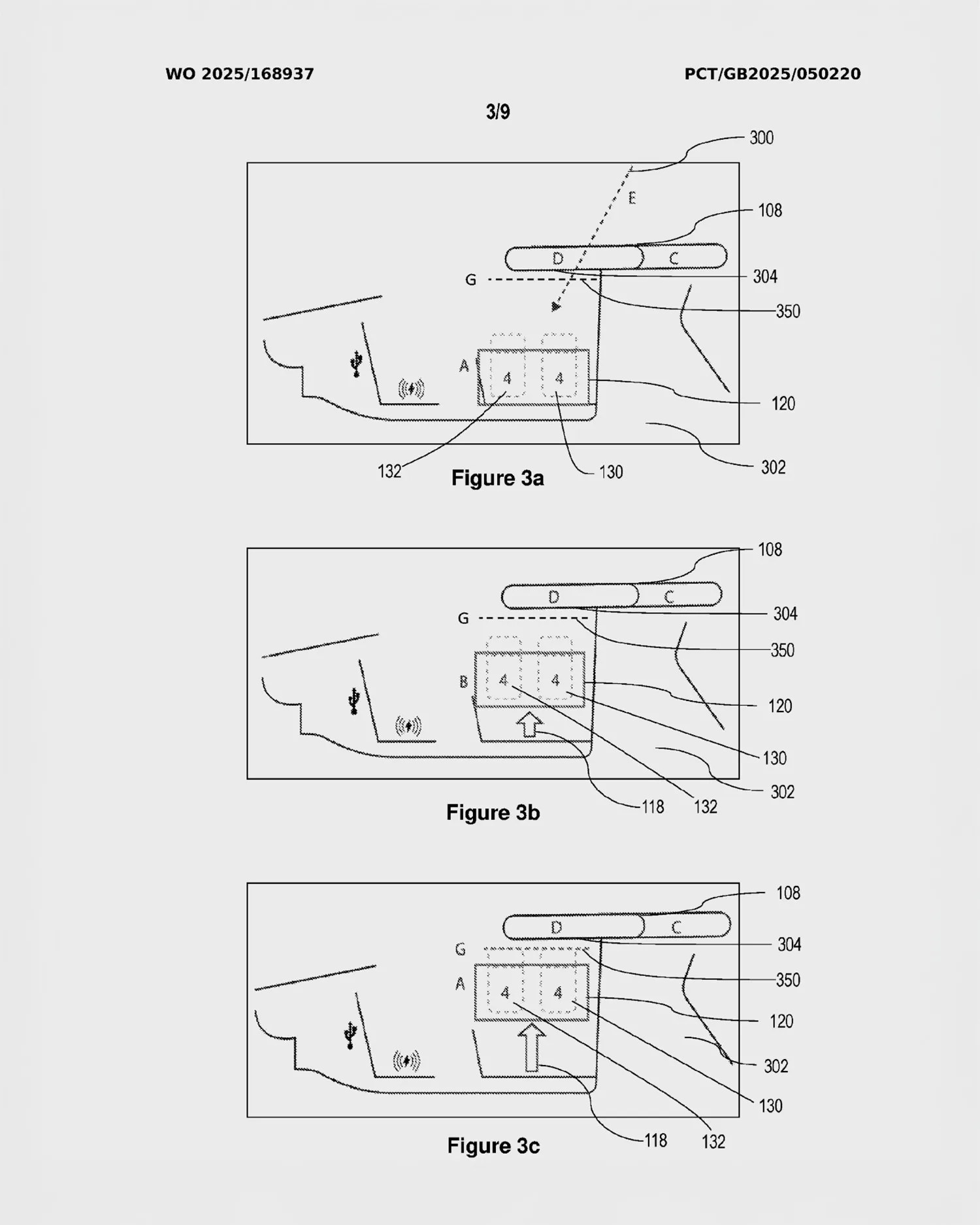
Three schematic diagrams labeled Figure 3a, Figure 3b, and Figure 3c illustrate a system involving a rectangular area (120) with two adjacent blocks labeled "4" (130 and 132) inside it. - In Figure 3a, a dashed arrow (300) points downward from an area labeled "D" and "C" (108) above a horizontal line (304) toward the rectangular area (120). The rectangular area is positioned above a base (302) and adjacent to a vertical boundary (350). The blocks "4" are inside the rectangular area, with the left block (132) near a symbol resembling a wireless signal and a USB icon. - In Figure 3b, the rectangular area (120) is shifted slightly upward (indicated by an upward arrow 118) and is now labeled "B." The blocks "4" remain inside, and the area "D" and "C" (108) above the horizontal line (304) remain unchanged. - In Figure 3c, the rectangular area (120) is further shifted upward (again indicated by an upward arrow 118) and is labeled "A." The blocks "4" remain inside, and the area "D" and "C" (108) above the horizontal line (304) remain unchanged. The diagrams appear to show a process of moving or adjusting the position of the rectangular area containing the blocks "4" relative to the base (302) and
In this diagram, Bentley’s height-adjustable cupholder patent pairs both vessels in one single recess.
Bentley / WIPO

Next-level drink accommodations

Although most conventional car cupholders make some semblance of provisions for adjustability, the reality is that there’s no one-size-fits-all guarantee.

With this in mind, Bentley has considered the advantages afforded by EVs — namely, the lack of a traditional drivetrain allowing for more space and deeper interior consoles — to design a setup that accommodates beverage containers of varying shapes and sizes.
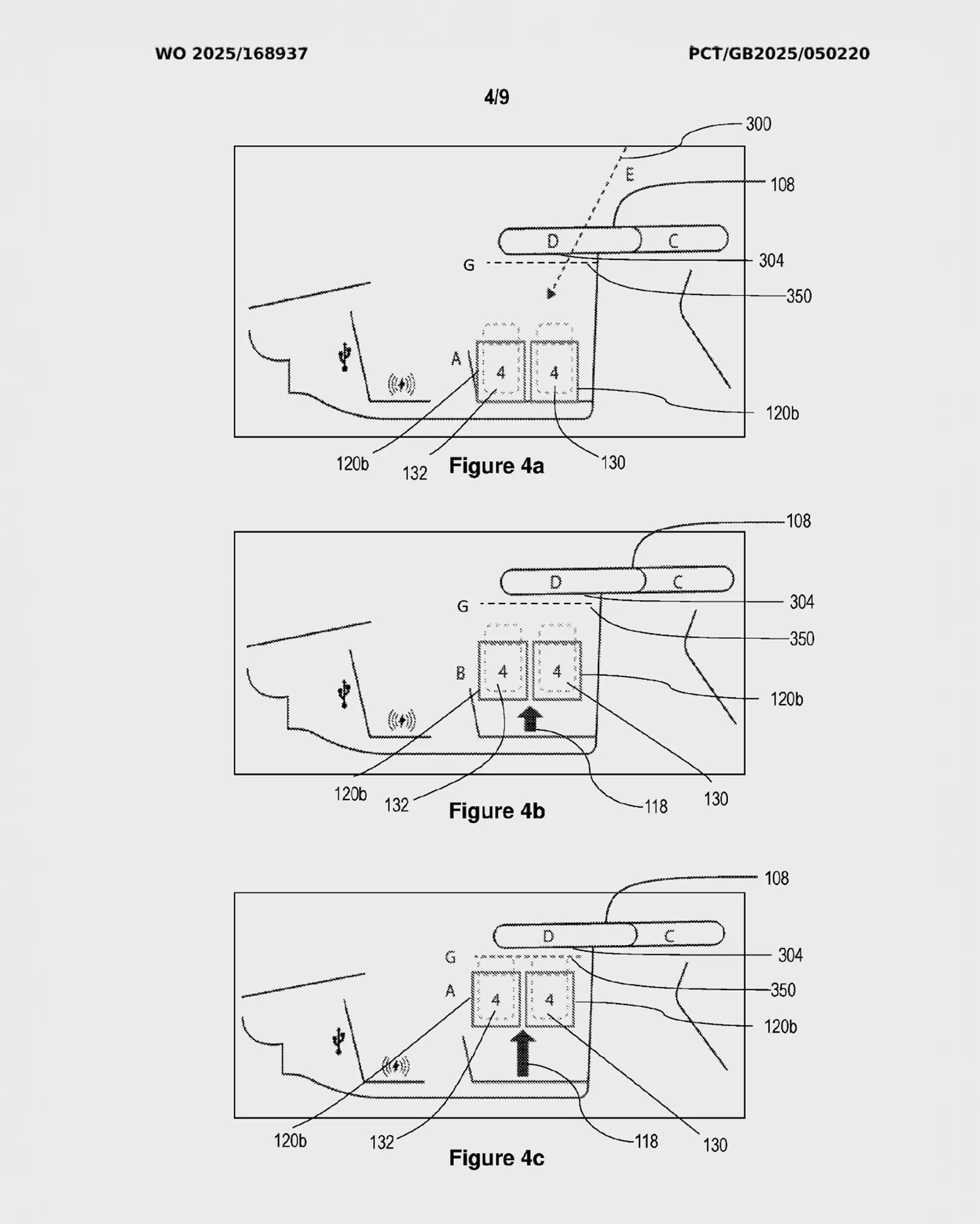
Three schematic diagrams labeled Figure 4a, Figure 4b, and Figure 4c, each showing a layout with two adjacent squares marked "4" inside a rectangular area labeled 120b. Above the squares, there are two elongated horizontal bars labeled "D" and "C" within a larger rectangular area labeled 108. A dashed horizontal line labeled "G" runs across the top of the squares. Arrows indicate movement or direction between the squares and the bars. Additional labels include 132, 130, 118, 304, 350, and 300, with a dashed diagonal line labeled "E" in Figure 4a. The diagrams appear to illustrate positional or interaction changes between the squares and the bars.
By contrast, this diagram illustrates the possibility of two individual cupholders that can be raised separately.
Bentley / WIPO

As reported by Carbuzz, the patent documentation outlines a cupholder configuration that includes both a height-adjustable recess and a power-actuated lid. 

In practice, this means that the car can theoretically house everything from a small coffee cup to a larger water bottle or soda of 1.2 liters or more.

The cupholder volume can change as needed, and the lid can open or close depending on the size of the vessel being stored.

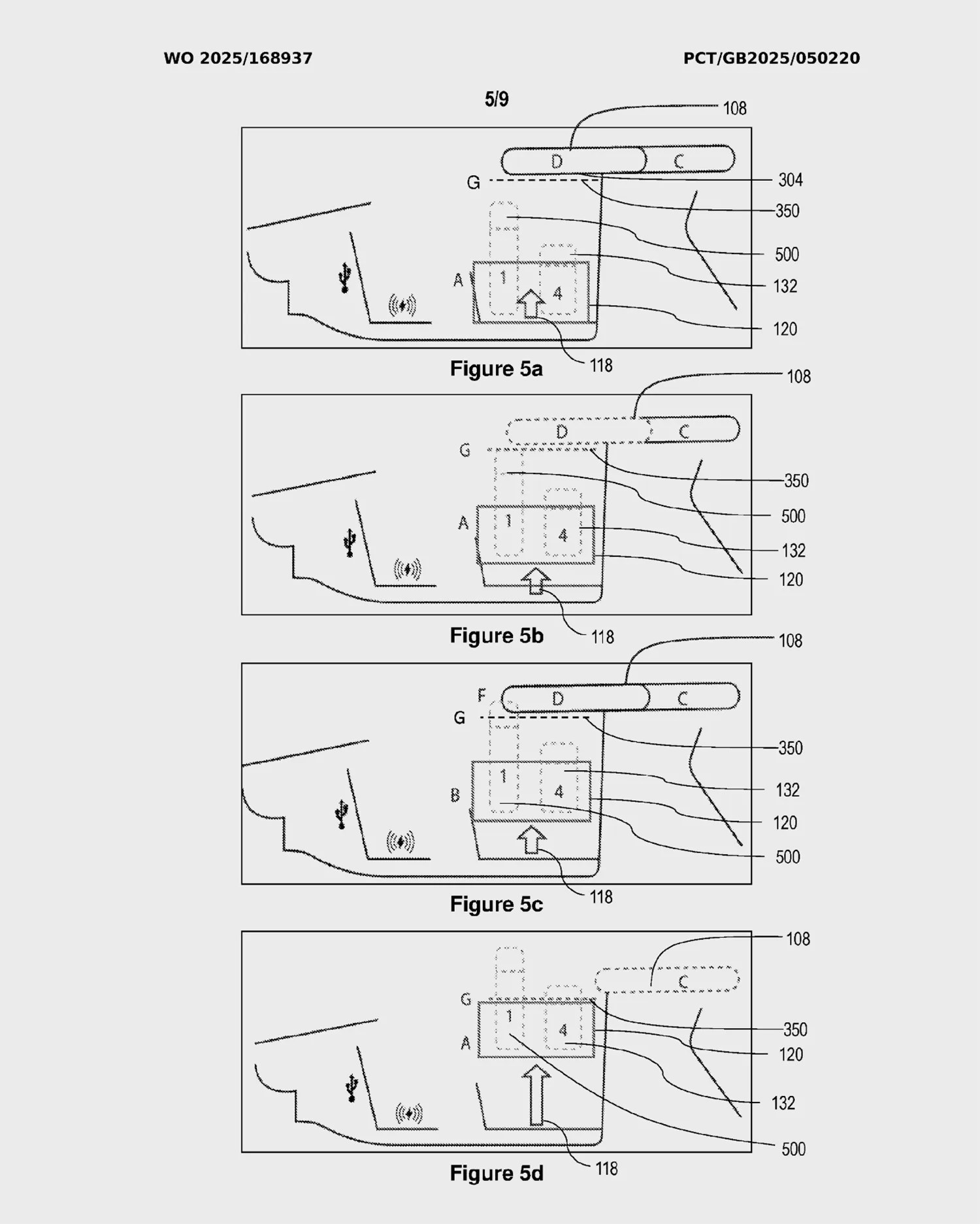
Diagrams labeled Figures 5a to 5d show a schematic interface with labeled elements including a rectangular box (118) containing numbers "1" and "4" and an upward arrow. Above this box is a horizontal bar (108) divided into sections labeled "D" and "C." Various lines connect these elements to labels such as 120, 132, 304, 350, 500, and letters A, B, F, and G. The diagrams depict different states or configurations of the interface, with some elements shown as solid lines and others as dashed or dotted lines, indicating changes or transitions between the figures.
In a single-recess setup, the lid does result in some height limitations.
Bentley / WIPO

More than luxury creature comforts

As you’d expect from a brand like Bentley, the patent does outline the potential for some more lavish features

Along with a means of heating and cooling the container being housed within the cupholder, the documentation also specifies elements like a locking mechanism and a sensor for automatic adjustment and deployment.

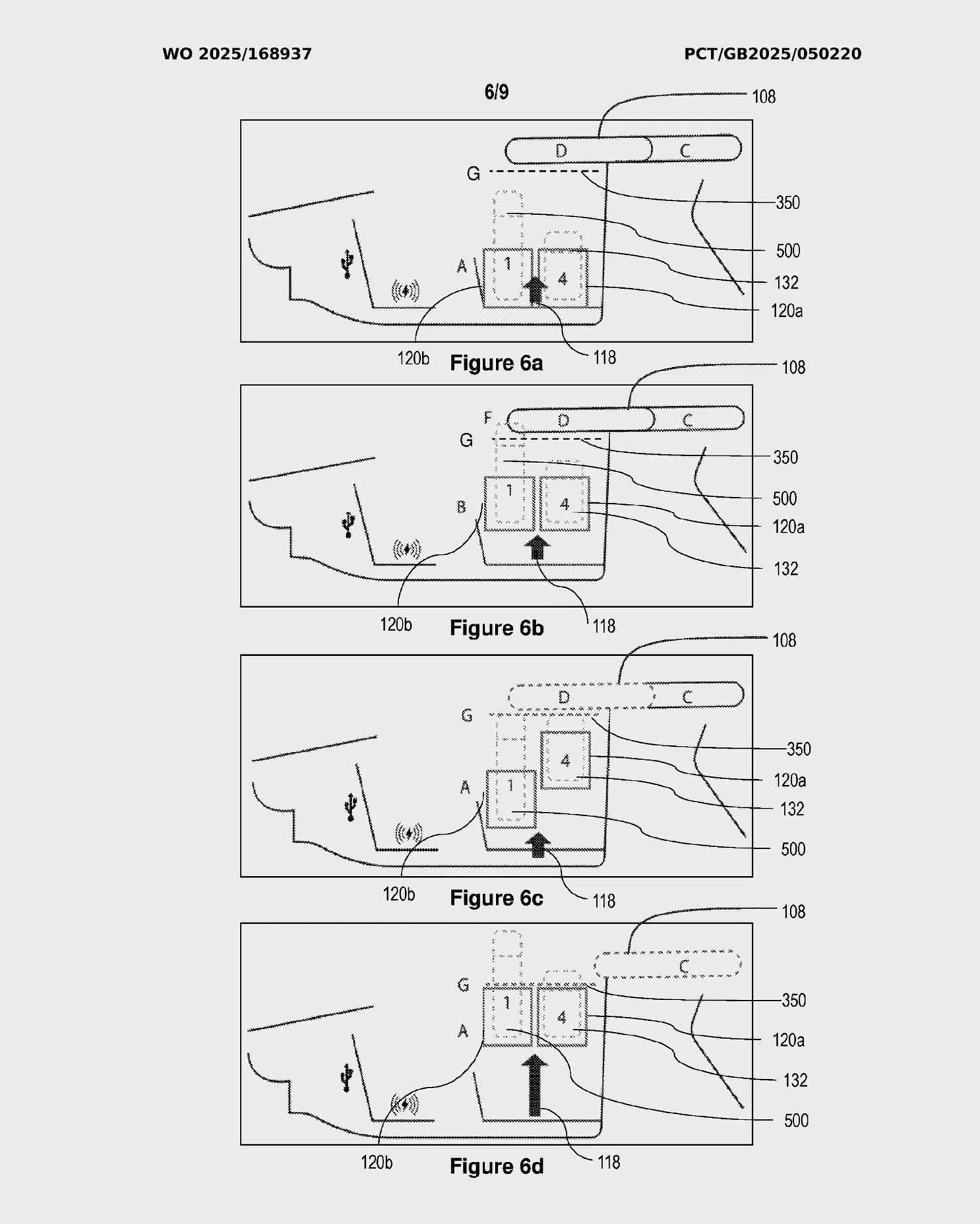
Diagrams labeled Figures 6a to 6d showing a sequence of a user interface with a map and selectable options. Each figure includes a map section with a USB symbol and wireless signal icon on the left, and two numbered square buttons labeled "1" and "4" near the bottom center. Above these buttons is a horizontal bar with two segments labeled "D" and "C." An arrow points upward from the buttons in each figure, indicating interaction or selection. Various reference numbers (108, 118, 120a, 120b, 132, 350, 500) label parts of the interface, with dashed lines showing changes in the highlighted or selected areas across the sequence. The figures illustrate changes in the selection or focus between the buttons and the horizontal bar segments.
With individual recesses, the cupholders can operate separately and seal against the lid even with varying heights.
Bentley / WIPO

However, Bentley does also highlight an unexpected benefit of its cupholder design — increased safety.

Thanks to the added enclosure element, it can keep a vessel and its contents secure during driving (or in the event of a crash).

Granted, it’s hardly a revolutionary concept. However, in combination with the volume-adjustable recess, it’s bound to make a difference when it comes to automotive beverage accommodations.

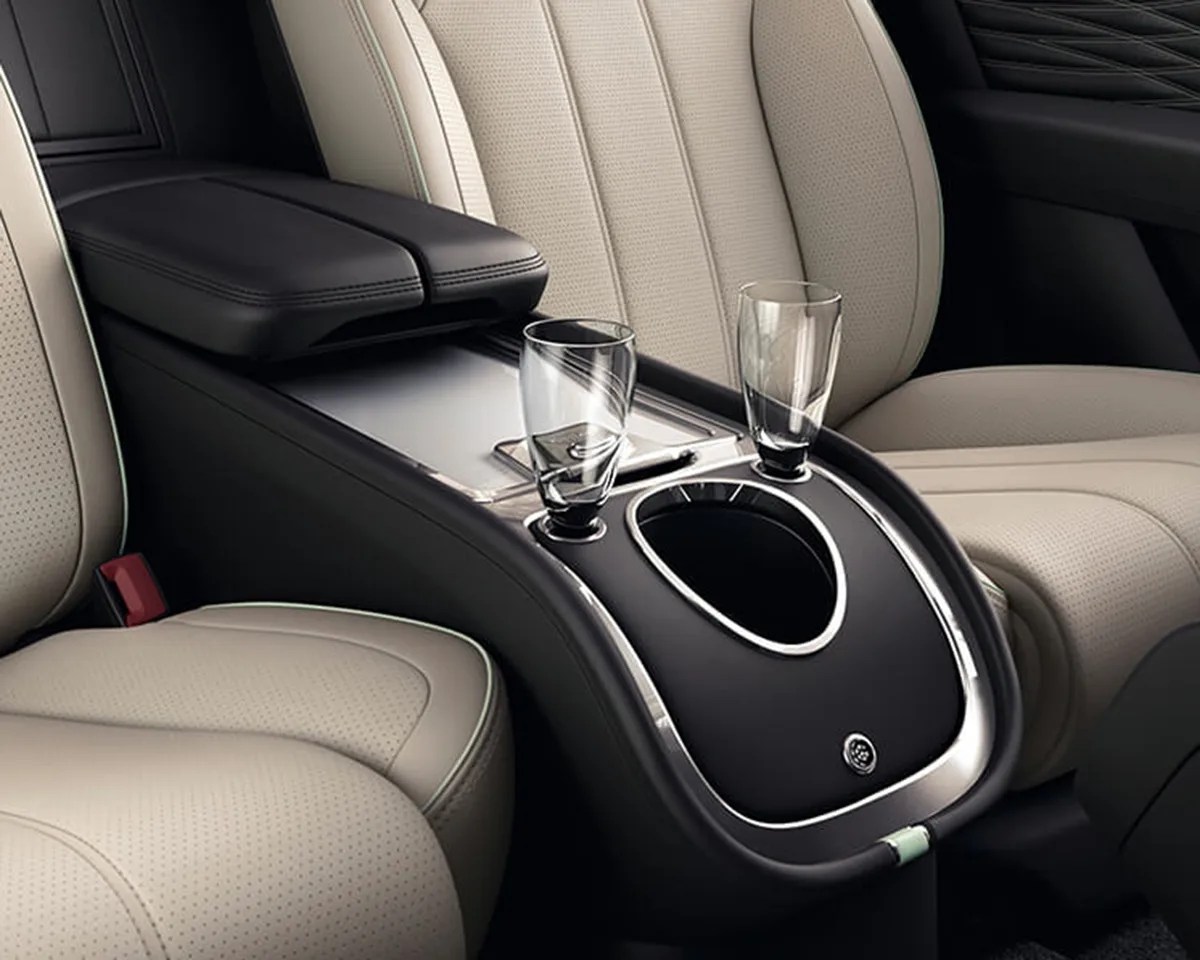
Car interior center console with beige perforated leather seats, featuring a black armrest, two transparent glasses in cup holders, and a sleek black and chrome trim design.
Bentley has a precedent for improving cupholders — this patent design could make it onto the road.
Bentley

Patent possibility

Though a patent filing offers some idea of what Bentley’s engineers are up to these days, it’s by no means a guarantee that this feature will appear on the road anytime soon.

Nevertheless, in an age dominated by ever-increasing screen sizes and over-the-air software rollouts, it’s refreshing to see a brand paying attention to the physical user interface.

If there’s one thing that’s to be gleaned from this kind of novelty, it’s that EVs are continuing to rewrite the rules of automotive interior design.

,