
The Omega Speedmasters Currently on Their Way to the Moon Aren’t What You Expect

Don’t worry, they’re more than up to the task.

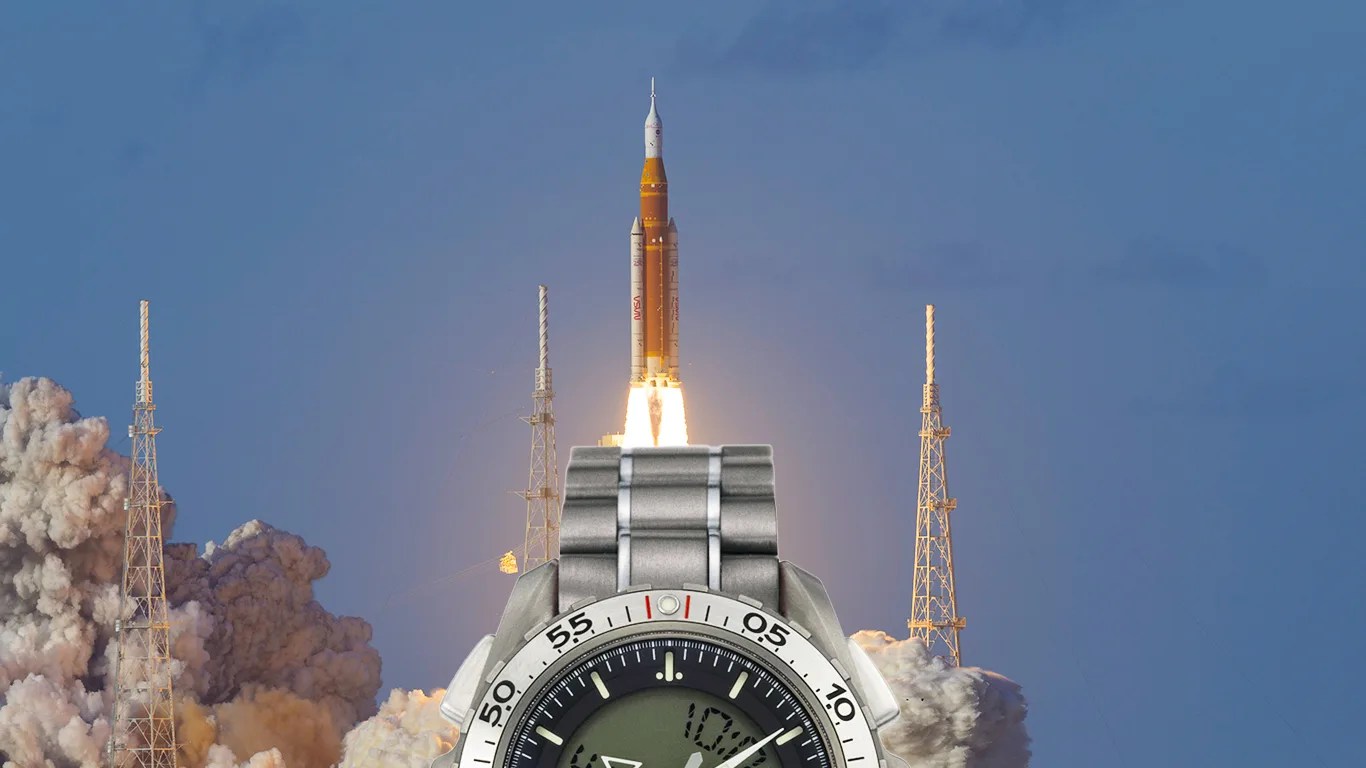
Silver metal digital wristwatch with black face and white bezel in front of a rocket launch.Bill Ingalls/NASA via Getty Images, Omega

On April 1, 2026, the crew of Artemis II made history (no foolin’).

The first crewed mission of the Artemis program saw astronauts Reid Wiseman, Victor Glover, Christina Koch and Jeremy Hansen blast off from Florida’s Kennedy Space Center on their way to the moon. While their Orion spacecraft won’t touch down on the lunar surface, its journey around our natural satellite marks the first time humans have traveled to the moon since the Apollo 17 mission in 1972.

During the Apollo 17 mission and all previous Apollo missions, the astronauts wore NASA-commissioned Omega Speedmaster Professionals, which is why the iconic mechanical chronograph is known as the Moonwatch today.

The four Artemis II astronauts also wore Omega Speedmasters on the outside of their suits when they boarded Orion to begin their 10-day journey. But it wasn’t the Moonwatch they chose to wear. Instead, it was a quirky Speedmaster that didn’t even exist the last time humans went to the moon.

Four astronauts in orange NASA spacesuits standing outside a building with NASA logos and "Freedom 250" signs.
The four astronauts of Artemis II with Omega Speedmaster X-33 watches strapped over their suit sleeves.
Chip Somodevilla/Getty Images

X-33 marks the spot

In 1995, Omega sent prototypes of a new Speedmaster to NASA for testing. Three years later, the production version of that watch debuted as the Speedmaster Professional X-33 “Marswatch.” Designed to meet the needs of modern astronauts, the X-33 was different from the original Speedy in nearly every way, retaining only the iconic lyre lugs and hour markers and … well, that’s about it.

The watch was powered by an advanced quartz calibre rather than a mechanical chronograph movement, and it featured an analog-digital display. There was a traditional minute track with hands and hour markers, but the dial itself was an LCD screen that was able to display various types of information.

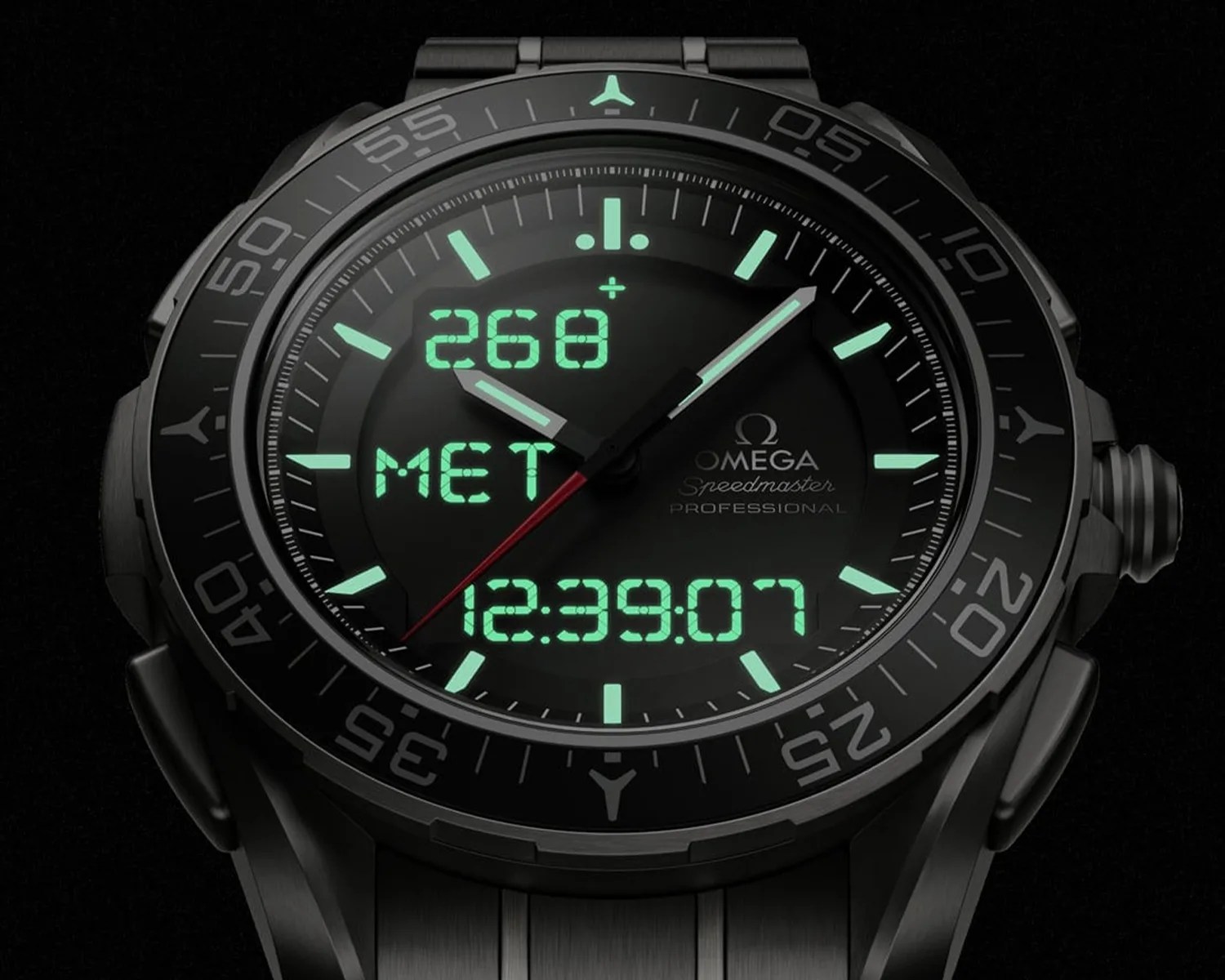
In addition to a classic chronograph function, it featured a perpetual calendar, multiple time zones and various timers and alarms, with the alarm reaching 80dB to make it audible in noisy mission environments. Its 42.25mm titanium case was festooned with four pushers in addition to the crown, and it featured a rotating timing bezel around the dial and a sapphire crystal.

The Marswatch was approved by NASA for flight on the Space Shuttle, but its shelf life was exceedingly short, and it was replaced by the X-33 Second Generation after just three years. The Second Gen was largely the same watch and used the same Calibre 1666, but it added some aesthetic improvements, including a brushed bezel and pushers and a lume pip on the bezel.

Omega Speedmaster Professional stainless steel watch with analog and digital display on a red background.
The Omega Speedmaster Professional X-33 Second Generation worn by the crew of Artemis II.
Omega

It, too, became flight-qualified by NASA before Omega discontinued it in 2006. But that’s not where the X-33 Second Gen’s story ends. Omega only discontinued the watch for public sale, and the watchmaker has continued to produce the watch specifically for NASA over the past 20 years.

Despite not being offered to the public for two decades, it’s the second generation of the Omega Speedmaster X-33 that is the watch of choice for the Artemis II astronauts, with all four crew members wearing the watches onboard Orion during the mission. The watch has built up a reputation as a favorite among astronauts, and its use on this high-profile mission should only serve to elevate its status.

The X-33 Second Gen remains standard issue to NASA astronauts, but its continued popularity is curious considering that Omega has produced newer, objectively better versions of the X-33 since 2006. Namely, the X-33 Skywalker, which has a ceramic bezel, a negative LCD display and a higher-spec thermo‑compensated quartz movement — something I think would come in handy in the cold of space, which is considered a weak point for the X-33 Gen 2.

Black Omega Speedmaster Professional watch with glowing green digital and analog display on a black background.
The X-33 Skywalker didn’t catch on with astronauts like its predecessor did.
Omega

Omega produced the Skywalker from 2014 until quietly discontinuing it in 2025. Currently, the only Speedmaster X-33 in Omega’s catalog is the Marstimer, which has features specific to the red planet and was introduced in 2022.

A new Moonwatch?

With the classic Speedmaster Professional nowhere to be seen on the Artemis II mission, does that mean we can expect the X-33 to be on the Artemis IV astronauts’ wrists when they land on the moon in 2028?

Don’t count on it.

an omega speedmaster watch on the wrist of an astronaut suit
The Speedmaster Professional remains the only watch qualified by NASA for extra-vehicular activity.
Photo by Johnny Brayson for Gear Patrol

While the X-33 is qualified for spaceflight by NASA, like the Speedy Pro, it is not qualified for extravehicular activity, or EVA. EVA refers to any time an astronaut exits their spacecraft, either in the vacuum of space or on the lunar surface. To date, there is only one watch that has ever been qualified by NASA for EVA, and that’s the classic Speedmaster Professional Moonwatch.

So, unless NASA approves the X-33 or another watch prior to the Artemis IV mission, which is anticipated to take place in two years, the Speedy Pro will most likely make its grand return to the moon, a place the watch first visited in 1969 but hasn’t seen since ’72.

I greatly look forward to the reunion.

Want to stay up to date on the latest product news and releases? Add Gear Patrol as a preferred source to ensure our independent journalism makes it to the top of your Google search results.

add as a preferred source on google
, , , ,