
Is Rolex Secretly Developing Its Toughest Watch Yet?

An intriguing patent filing for a new case structure hints at some tantalizing possibilities.

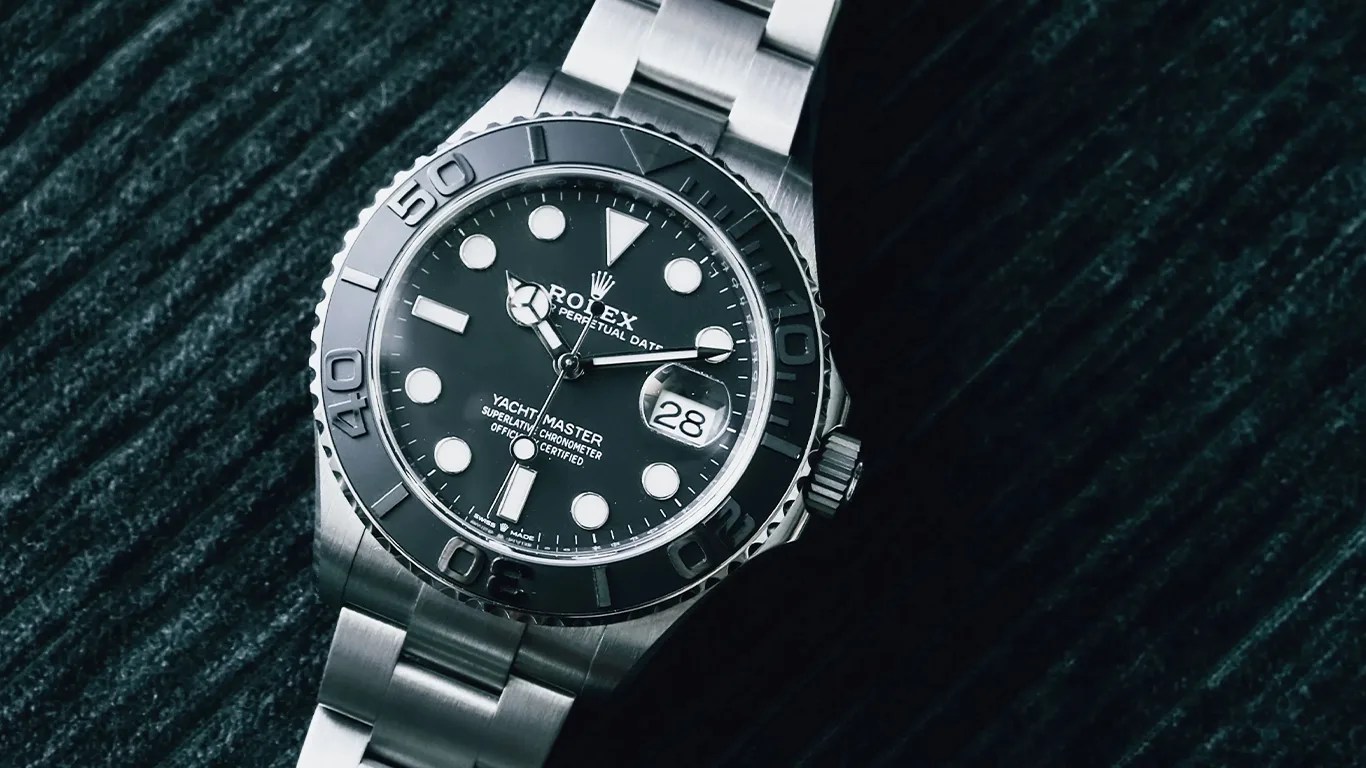
Silver Rolex Yacht-Master watch with black dial and date display on a textured dark surface.Photo by Zen Love for Gear Patrol

Rolex has arguably made more contributions to horology in the past 100 years than any other brand, with one of the most enduring being the brand’s Oyster case.

First launched and patented by the brand in 1926, the Oyster case is widely considered the world’s first waterproof wristwatch case, thanks in part to its incorporation of a screw-down crown and screw-in caseback that seal the interior of the watch from water ingress.

Even today, modern versions of the Oyster case are used by Rolex in nearly all of its models from both its Classic and Professional collections. But a new patent filed by The Crown suggests that Rolex may be eyeing a change to the Oyster case, at least in some cases (no pun intended).

Welcome to Moonshots: A series exploring the big ideas that could reshape the future of products. Discover more here.

rolex watch on a beach
Is Rolex’s iconic case design about to get a revamp?
Rolex

A tougher Oyster?

The new patent filing was uncovered by — who else — Instagram’s top horological sleuth, Nick Gould, AKA @niccoloy. It’s pretty mysterious, but undeniably intriguing.

In the filing, there’s a sketch of a Professional Oyster case that most closely resembles the Yacht-Master Titanium due to the prominent chamfer running along the lug, but it’s likely a brand-new case. On the sides of the case are a number of tiger-like stripes, which are meant to be filled with a different material from the rest of the case.
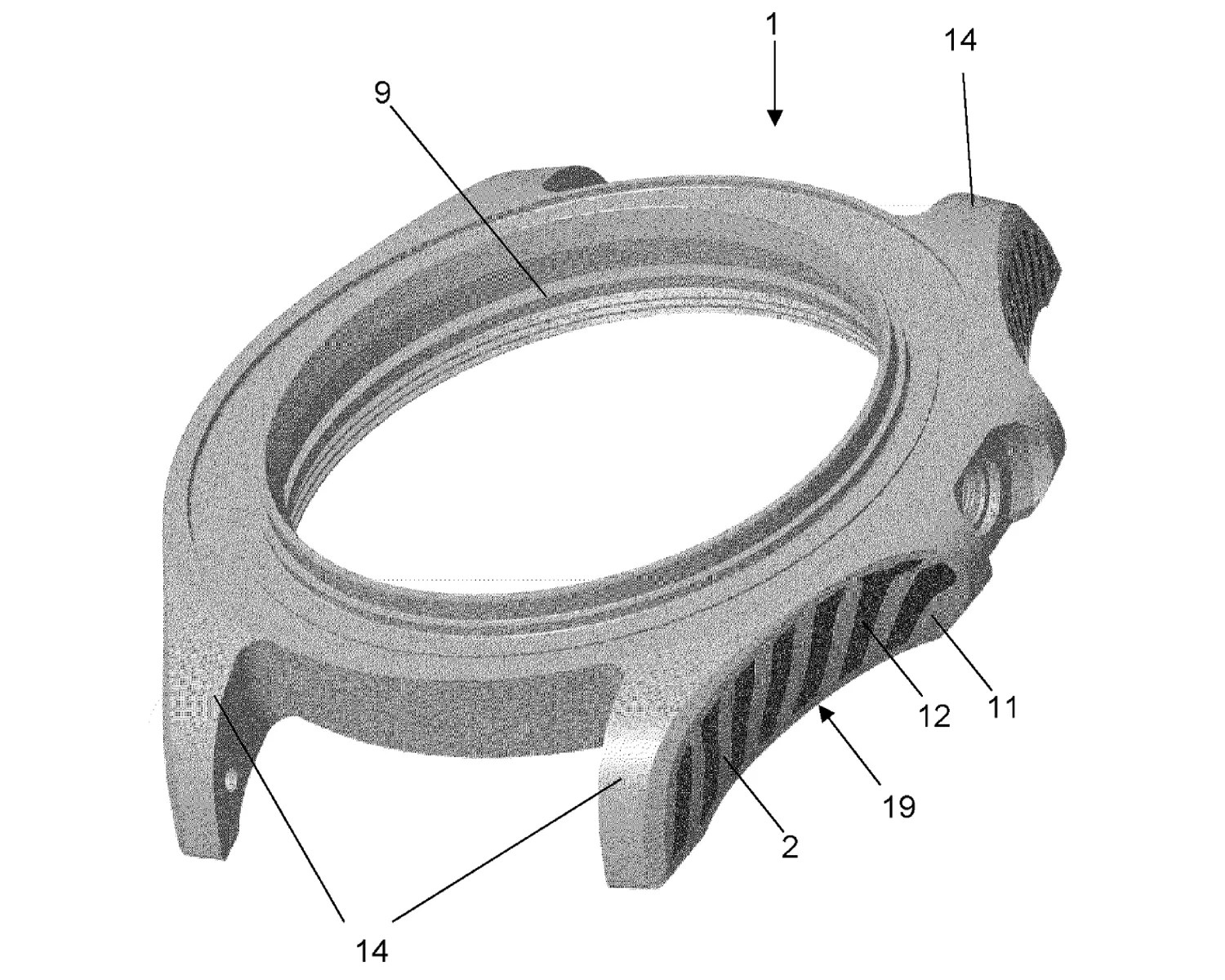
The patent goes on to describe a system with a case made up of one material in a “porous structure” whose channels are filled in with a second, amorphous material. One part of the lengthy filing sheds a bit more light on what’s going on here, implying that the case — which has a lattice-like structure on its sides — is to be made of a metal alloy and/or ceramic, with a resilient polymer or rubber substance filling in the channeled sides.

Watch case with labeled parts including bezel area (9), side grip (11), textured side panel (12), lugs (14), and vented section (19).
While it may look like titanium Damascus in the drawing, the reality of what we’re looking at here is far more complex.
Rolex

Here is that section, translated from French:

Watch component (1) for a watch part according to any one of the preceding claims, characterized in that the first material (11) of the porous structure (2) is based on or consists of a metal or a metallic alloy, in particular a precious alloy or a metallic superalloy, in particular comprising one or more elements among Fe, Mg, Al, Ti, Au, Pd, Pt, Ni, Si, and/or Co, and/or is based on or consists of an amorphous or partially amorphous alloy, and/or is based on or consists of a ceramic, in particular based on alumina or zirconia.

Watch component (1) for a watch part according to any one of the preceding claims, characterized in that the second material (12) is based on or consists of a resilient material, such as a polymer, in particular an elastomer such as a thermoplastic elastomer (TPE) or thermosetting elastomer or a fluoroelastomer (FKM, FFKM or FEPM), or a natural (NR) or synthetic (SBR, HNBR, EPDM) rubber, or a vinyl methylsilicone (VMQ) or a fluorosilicone (FVMQ) and/or is an elastomer of Shore A hardness greater than or equal to 40, or in that the second material (12) is an amorphous alloy or a partially amorphous alloy.

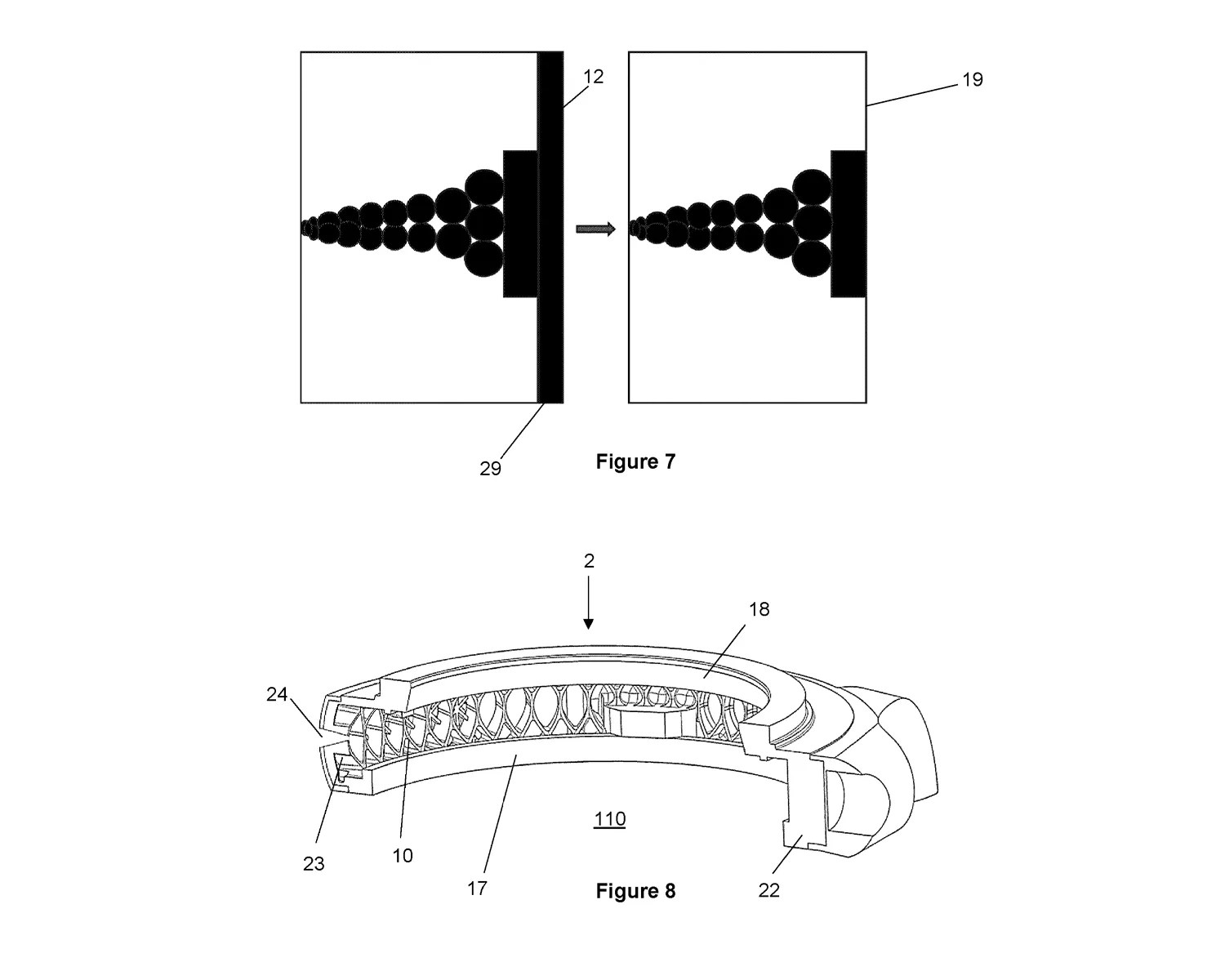
Figure 7 shows two diagrams of a cone-shaped array of black circles decreasing in size from right to left, with a black rectangular base, transitioning from one labeled 12 and 29 to another labeled 19. Figure 8 is a cross-sectional view of a curved mechanical component with internal lattice structure and labeled parts 2, 10, 17, 18, 22, 23, and 24.
Here, you can see the lattice-like interior of the case sides.
Rolex

The patent goes on to describe the filled-in rubber portion as the “reinforcement structure” and the case as the “shell.” It also says the two together will form a “single-piece monobloc structure” — which sure doesn’t sound like an Oyster case — and even sheds some light on the manufacturing process, specifically describing “the injection of the second material from a first surface of the watch component, in particular at a temperature between 100°C and 250°C and at a pressure between 50 and 200 bars.”

This is all pretty mysterious, but my best guess is that Rolex is seeking to patent a new manufacturing process resulting in a monobloc case made up of metal or ceramic(!) shell surrounding some sort of rubber reinforcement structure.

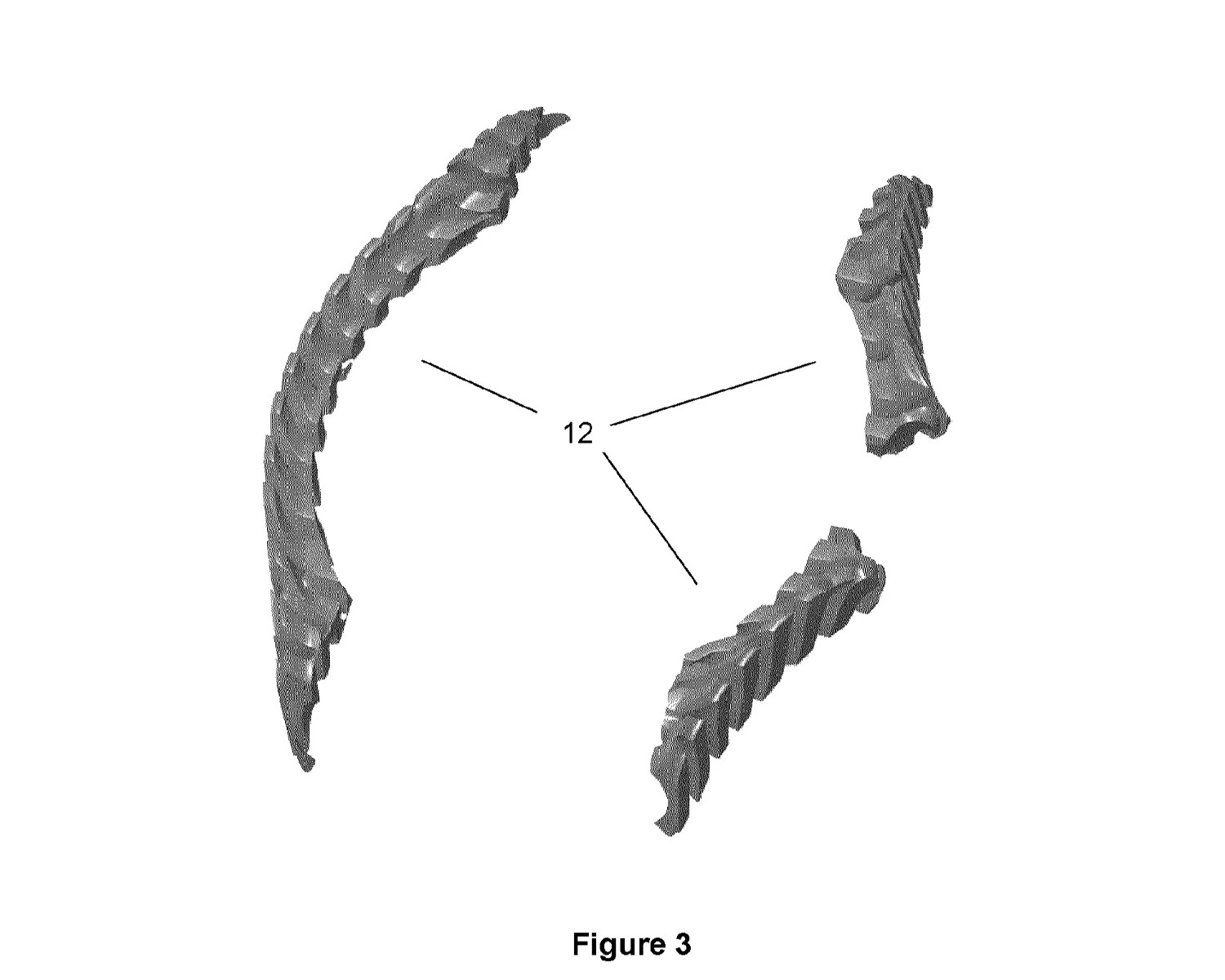
Three segmented, curved, textured objects arranged around the number 12 on a white background.
The rubber reinforcement structure on its own.
Rolex

Now, on to the question of why. If Rolex actually plans on making such a case, you can be sure it will have a practical application. Maybe this is a way to strengthen the case while also making it lighter and adding a little visual flair via the rubber-exposing stripes on the sides of the case? (The patent, for what it’s worth, is titled “Light and Decorated Timepiece Component.”)

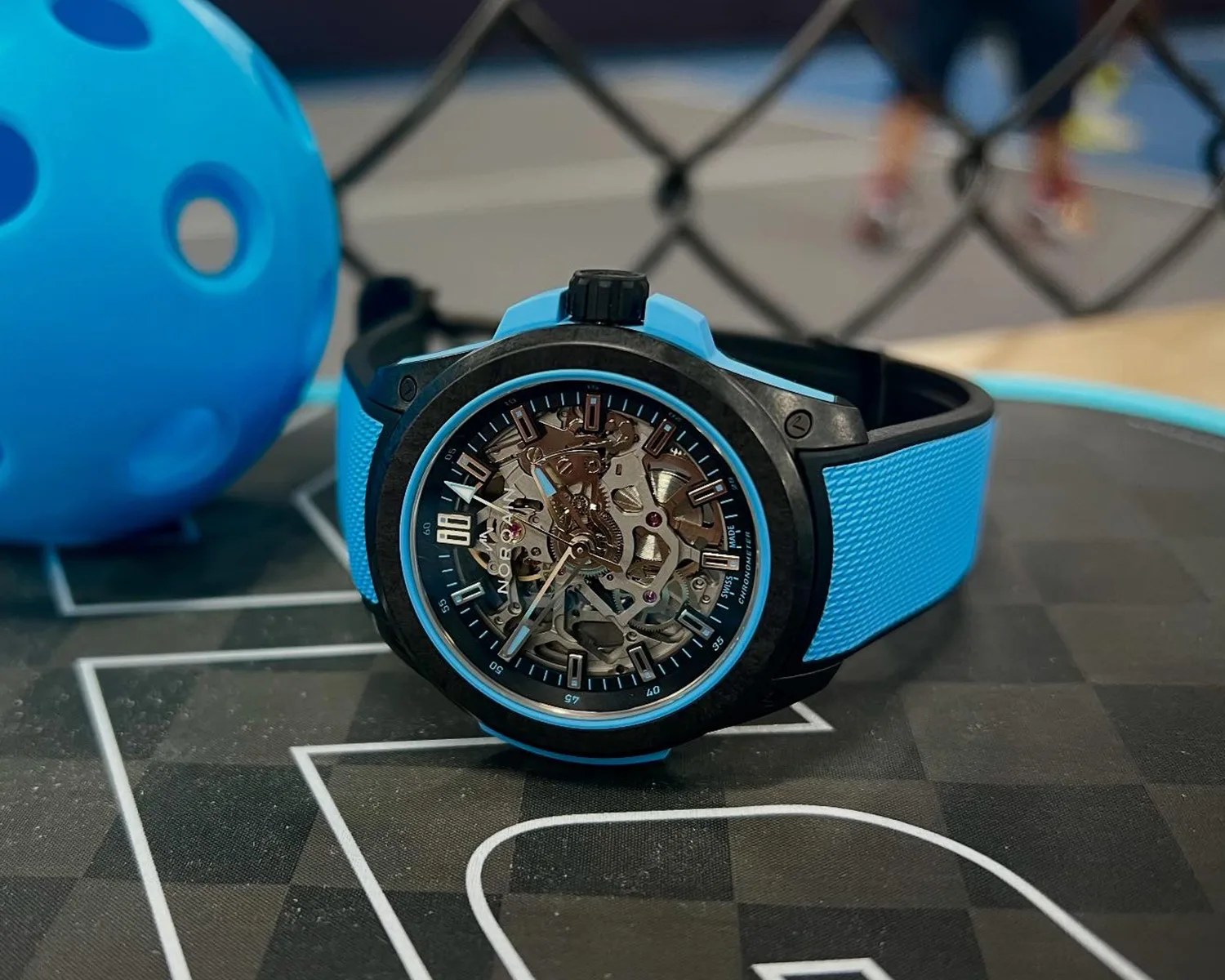
Looking at all of this, the watch I’m most reminded of is the Norqain Wild One, which features a rubber inner case designed to absorb shocks surrounded by a carbon fiber shell.

A Norqain wristwatch with a blue textured strap and a black bezel. The watch face is skeleton-style, showing the intricate inner mechanical gears and components. The watch is placed on a surface with a black and white geometric pattern, and a blue ball with holes is visible in the background.
Is Rolex about to take Norqain’s rubber-reinforced case design to the next level?
Photo by Johnny Brayson for Gear Patrol

The Norqain is marketed as a rugged luxury adventure sports watch, so might this be Rolex’s way of entering that realm in a more deliberate way? Could The Crown be working on what may ultimately be the toughest case it’s ever made?

That is a tantalizing possibility, and while the reality may ultimately prove more mundane (or never even come to fruition, as Rolex files a ton of patents that never see production), I like to think that Rolex’s greatest adventure watch yet may be on the horizon.

Want to stay up to date on the latest product news and releases? Add Gear Patrol as a preferred source to ensure our independent journalism makes it to the top of your Google search results.

add as a preferred source on google
, , , , , ,